
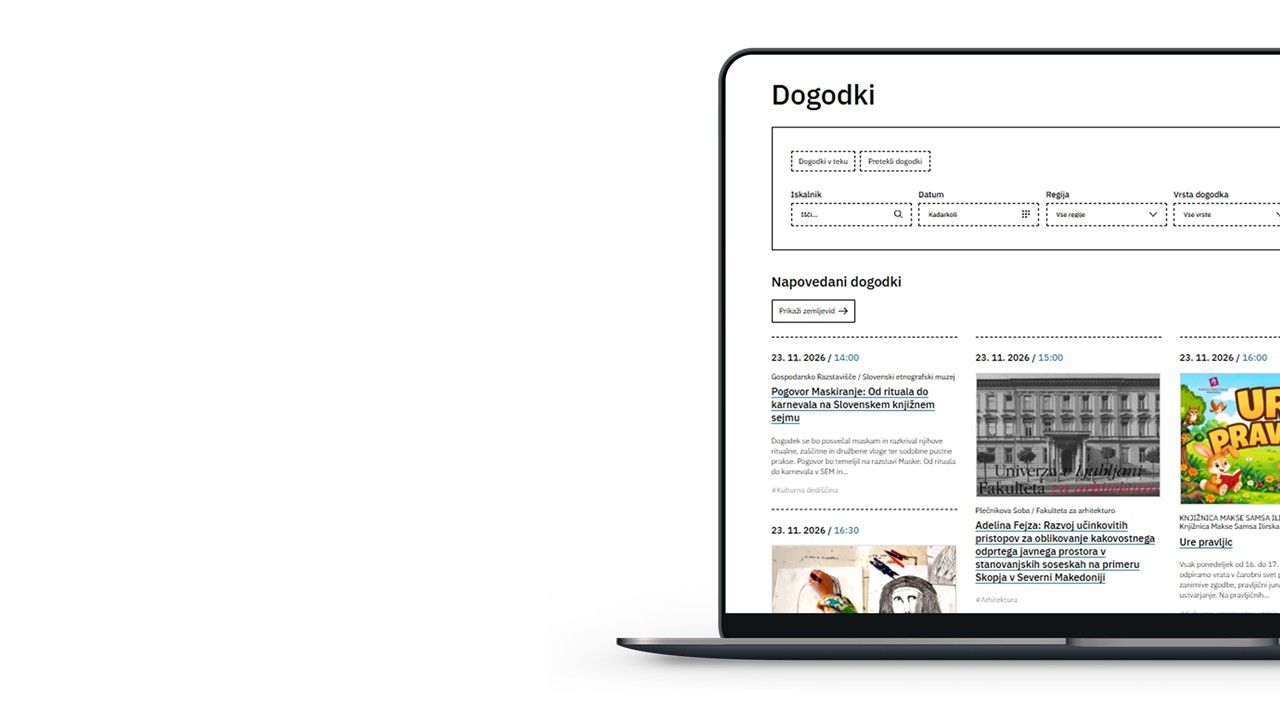
Modular Platform for Content Aggregation and Display
From Scattered Information to One Accessible Platform

The Challenge
Information about cultural events, organizations, news, and collaboration opportunities is often scattered across numerous websites without a consistent structure. Collecting, categorizing, and updating this content manually requires considerable editorial work, while maintaining automated collection tools demands specialist technical support.
At the same time, users expect a comprehensive, accessible portal where they can easily find relevant information through search, filters, and interactive maps, across different devices.
Solution
Our modular platform for content aggregation and display brings automated content collection, AI-powered categorization, and an accessible information portal into one solution.
The platform collects content from hundreds of web sources and uses large language models to identify relevant information and organize it into categories. Editorial corrections help improve the collection and categorization process over time.
A central content management system enables editors to manage content, categories, users, and integrations with external systems. The public-facing portal provides advanced search, filtering, and interactive maps to help users explore cultural information.
Its modular architecture allows individual components to be used independently or combined and extended according to project needs, supporting event listings, news, directories, and collaboration opportunities.
- AI-Powered Content Collection: Automatically collect and categorize content from hundreds of web sources, reducing manual editorial work.
- Flexible Modular Architecture: Combine and adapt modules for events, news, directories, maps, and collaboration opportunities.
- Centralized Content Management: Manage content, editors, categories, and external integrations through one interface.
- Advanced Search and Exploration: Help users find relevant information through search, filters, and interactive maps.
- Connectivity and Data Exchange: Connect with external APIs and share data in standard formats, including XML, JSON, iCal, and ATOM.
- Accessibility and Responsive Design: Support different devices and accessibility needs through WCAG 2.1 compliance and accessibility customization options.
- Open-Source Technologies: Avoid proprietary license dependencies and support future development through open-source technologies and comprehensive documentation.
Get in touch to explore your possibilities.