
CLASSICA project publication
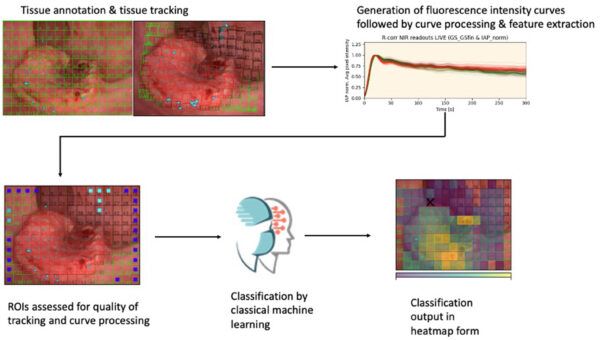
A new Knowledge Unwrapped feature summarises the CLASSICA publication “Technical and functional design considerations for a real-world interpretable AI solution for NIR perfusion analysis (including cancer)”, published in EJSO in March 2024. The article, authored by Alice Moynihan (previously University College Dublin), Patrick A. Boland, (University College Dublin), Jernej Cucek (Arctur), Samo Eržen (Arctur), Niall Hardy (previously University College Dublin), Jan Rojc (Arctur), Philip D. McEntee (University College Dublin), and Professor Ronan A. Cahill (University College Dublin and Mater Hospital Dublin), explains how artificial intelligence can be applied to near-infrared (NIR) fluorescence imaging to support real-time surgical decision-making.
Why this work matters
Accurate assessment of tissue perfusion is crucial for safe colorectal surgery. While NIR imaging with indocyanine green (ICG) is widely used, interpretation can vary between surgeons. By quantifying fluorescence as intensity–time curves and applying interpretable AI models, variability can be reduced and more consistent, objective feedback provided. The same approach also supports in-situ cancer characterisation, where perfusion differences help distinguish malignant from benign tissue.
How the system works
The CLASSICA-OR software connects directly to surgical video systems. After ICG injection, it automatically tracks regions of interest in the NIR video, generates fluorescence curves, and extracts perfusion-related features. Interpretable machine-learning models then classify tissue types. The system is designed specifically for real clinical environments, with automated region selection, live image-quality alerts, and intuitive visual outputs tailored for surgical use.
Intended impact
The technology aims to:
- provide objective, real-time support for perfusion assessment,
- assist surgeons in identifying tumour tissue during colorectal surgery, and
- deliver AI decision support in a transparent, clinically interpretable format suitable for regulatory approval.
Ultimately, this could improve patient outcomes and reduce complications or re-operations.
What comes next
A multicentre clinical study within CLASSICA is currently validating the system in real surgical settings. After clinical validation, the technology will move toward guiding targeted biopsies, with the long-term goal of achieving medical device approval for use across Europe.